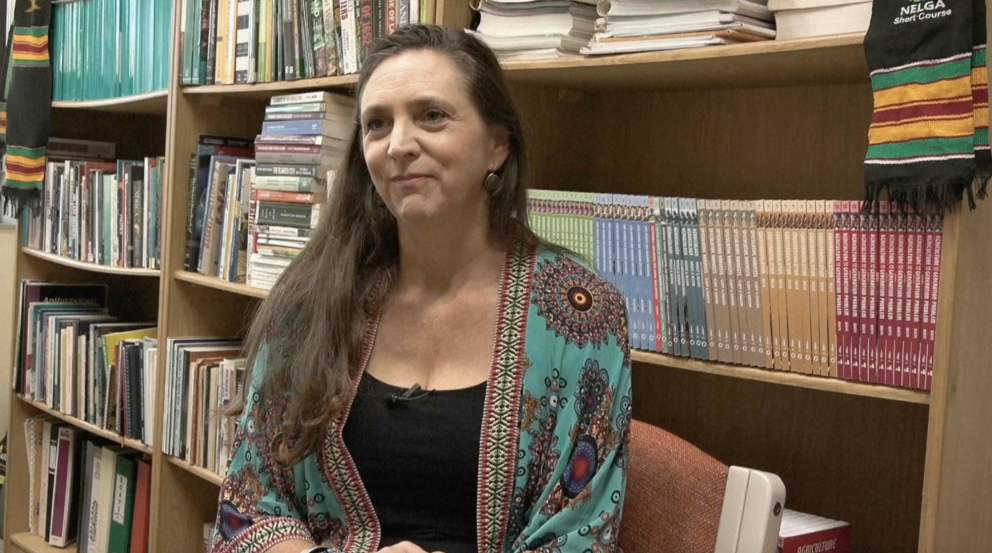

In January, South Africa signed into law the Expropriation Act 13, a land reform policy meant to rectify land inequity in the country. President Trump has called out this new policy as unfairly “confiscating” land. In this video, Professor Ruth Hall explains what the South Africa Expropriation Act is, what it intends to accomplish in a democratic post-apartheid South Africa, and clarifies some misconceptions about the new policies.
Professor Ruth Hall is the South African Research Chair in Poverty, Land and Agrarian Studies at the University of the Western Cape in South Africa. She studies land reform and land equity, and has served as an advisor on President Cyril Ramaphosa’s land policies. You can find some of her research here: https://scholar.google.co.za/citations?user=v89L4UEAAAAJ&hl=en
You can read the Expropriation Act here: https://www.gov.za/documents/acts/expropriation-act-13-2024-english-sepedi-24-jan-2025
>>>>>>>.
The Associated Press receives financial support for global health and development coverage in Africa from the Bill & Melinda Gates Foundation Trust. The AP is solely responsible for all content. Find AP’s standards for working with philanthropies, a list of supporters and funded coverage areas at AP.org.
>>>>>>>>>>>>>>>>>>>
Please credit: Ruth Hall, University of the Western Cape
AP in partnership with the University of the Western Cape
Location: Bellville, South Africa
[00:00:00]
We have a new law in South Africa, the Expropriation Act. It does not allow arbitrary deprivation of property. It does not allow confiscation of land. What it does do is it brings our legislation in line with our Constitution, which says that the state may expropriate to help to restore land to Black people who were dispossessed during apartheid.
[00:00:26]
We must distinguish expropriation from confiscation. Expropriation is eminent domain. It is that power. The state is allowed to identify properties that are required for a certain purpose and engage with property owners, either to come to an agreement, or where there is dispute, there is jurisdiction by the courts.
[00:00:47]
White South Africans, who constitute a minority of the population, still own most agricultural land, particularly high value agricultural land that was previously set aside exclusively for white occupation.
[00:01:00]
The vast majority of South Africans are Black people, and the vast majority of South Africans have no rights to land, none. Not to the land that their ancestors were on, not to the land where they live.
[00:01:14]
Under apartheid through most of the 20th century, Black people were not allowed by law to own land. Our patterns of inequality, racial inequality in land ownership, stem from that. Making South Africa, in most years, the most unequal society in the world.
27 February 2025
