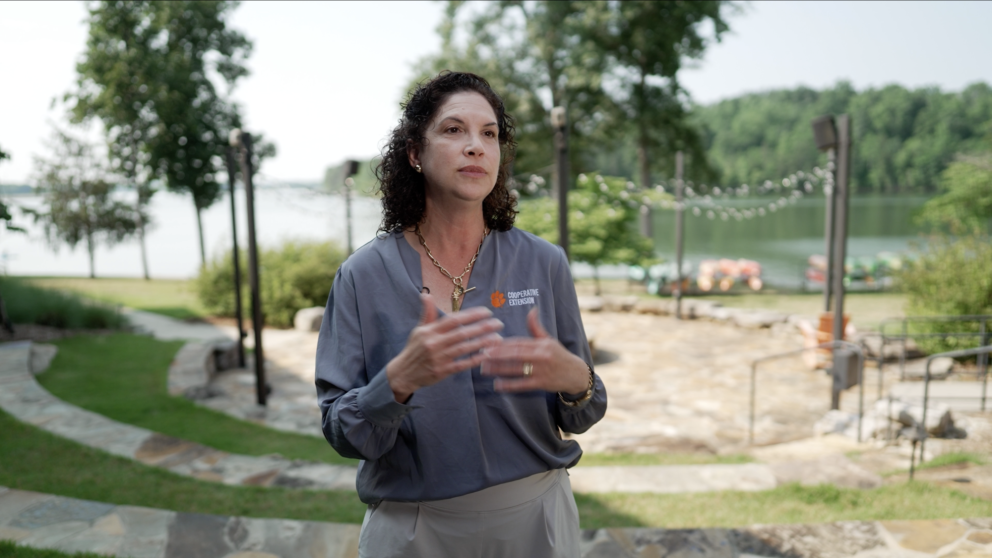

As summer travel to beaches, lakes, and rivers is in full swing, Clemson University expert Susan Lunt offers essential advice for protecting our waterways from pollution. Lunt explains how everyday choices like using reusable items, properly disposing of pet waste, and responsibly managing beach day supplies can significantly reduce pollution. She emphasizes the long-term environmental and economic consequences of litter and highlights how each visitor can be part of the solution by adopting simple “pack in, pack out” habits.
Susan Lunt is the Carolina Clear coordinator and water resource extension associate with Clemson Cooperative Extension. Susan has worked as an educator teaching middle school, high school and college classes. Prior to teaching, Susan served as an Environmental Engineer for the Goodyear Tire and Rubber Company and has previous experience working for the Ohio Environmental Protection Agency and Environmental Consulting Firms.
Headline: How to protect your favorite beach this summer
Slug: beach-pollution
Sources: Clemson University
Disclosures/Affiliations: N/A
Location/Date: Clemson University - June 6, 2025
Provider Reporting Tags: Clemson University
Provider Keywords: beach, lake, river, water pollution, waterways, summer beaches, beach pollution, sustainability, environmentalism, beach clean ups, pollution, sustainable tourism, summer tourism, pollution prevention, environment, AP Campus Insights, Clemson University
Copyright Holder: Leave blank.
Copyright notice: Leave blank.
Location: Clemson, South Carolina, United States
Restrictions: Please credit Susan Lunt, Clemson University.
00;00;00;00 - 00;00;17;23
Hello, my name is Susan Lunt and I'm the Carolina Clear coordinator and water resource extension associate with Clemson University Cooperative Extension Service. My focus is on public education and outreach and public involvement as it relates to water resources throughout the state.
00;00;19;27 - 00;00;46;03
So, if you're planning a trip to beach, lake, or river for a day of fun, there's a couple of things that you can do that are going to help protect those waterways. You want to think about reusable items as you want to leave nothing behind. So, if you can bring a reusable water bottle, also bring the types of silverware, plates, napkins that you can take back home with you and wash and reuse. That's better for the environment and less likelihood of getting left behind.
00;00;48;25 - 00;01;04;04
If you plan to bring your pets, then you'll want to bring disposable pet waste bags or containers to collect that. And again, that should go in your trash and go out with the waste that you would normally dispose of with your household waste.
00;01;06;28 - 00;01;30;07
So, if you're planning a day of fishing, you want to look at anything that you are putting into the water. So, any types of fishing supplies, if you're doing shellfish harvesting and you're purchasing the items, look to make sure that they are safe for aquatic use and use them per the label. Then you can feel confident that you are not negatively impacting our environment.
00;01;32;19 - 00;01;56;22
Okay, so summer tourism plays a role in water pollution, but it doesn't have to. Obviously if you increase more individuals to a certain area, you're increasing the amount of items, contaminants, products and all those types of things. But you can be a part of the solution, not a part of the pollution. So, you can think ahead about your activities and what you want to do.
00;01;56;22 - 00;02;26;09
You can actually leave that environment better than it was when you arrived. So, when you come, think about doing a beach or a river sweep as part of your activity, bringing the appropriate bags and such to pick up stuff like that. Within your own setting make sure that you and your family and your friends that are arriving aren't leaving anything behind so that you're bringing the proper items that can be reused and recycled and that you're taking away anything with you.
00;02;28;22 - 00;02;57;12
So, if cleanup efforts are inconsistent when it comes to litter and pollution, there is a long-termimpact on our waterways. It impacts the health of humans, wildlife, our environment and the economics. We will see degradation in our environment as there will be trash, and it won't look appealing. And it's also unhealthy for the plants and the animals and the environment, both on land and in water.
00;02;57;12 - 00;03;18;18
That can directly impact the economics because if it's unsightly, individuals aren't going to want to come and if it's unhealthy or things are closed, individuals aren't going to come. Then we see our aquatic organisms in the greater ecosystem suffering, which is all part of the food chain and will directly impact us in time.
00;03;20;25 - 00;03;51;20
So, the importance of pack in, pack out principles when it comes to visiting lakes, rivers and beaches is very important. This idea that you know exactly what you're bringing in and you can plan to bring it all out. Leaving nothing behind helps ensure the health and beauty of the venue that you went to visit. And with some pre-planning, this can be very easy, so make sure to think about the items that you are bringing for the day and think about taking reusable things that will be later be recyclable.
00;03;51;20 - 00;04;17;21
So reusable water bottles, the utensils and plates and napkins that you bring in, toys, anything like that. Make sure that you have the proper bins and trash bags that you can use to then take it all back with you. Make sure that it gets into the proper trash, recycling or composting when you are done and that will make for a much better day and a better environment.
00;04;19;23 - 00;04;44;00
So I often hear people say it's just one plastic bottle or it's just one piece of trash, so I'm not going to make a difference. But quite the opposite, the cumulative effect of every piece of litter,trash or plastic bottle creates a huge problem for our health, our environment and our economics. So, it's very important that you be a good Earth steward and be responsible and you're setting that role model.
00;04;44;00 - 00;05;02;05
Because just as all those items have a cumulative effect, you throwing things away properly, you encouraging others to do the same has a cumulative effect on our health, our environment and the economic impact. So, everyone can make a difference.
14 October 2025
