
[Shenzhen, China] — On September 29, 2026, Richard Yu, Executive Director, Chairman of the Investment Review Board, and Chairman of the Board of Directors of the Consumer BG, talked with journalists from some international media outlets about Huawei's consumer business and HarmonyOS ecosystem. The following is a summary of the roundtable:
Richard Yu: I joined Huawei in 1993. That was 33 years ago. At the time, the company had just a few hundred people. Right now, we have more than 200,000 employees, and almost half of them are engaged in R&D.
Between 2007 and the end of 2025, Huawei invested more than CNY1.8 trillion into R&D. In the early years, we reinvested around 10% of our annual revenue into R&D; in recent years, that proportion has jumped to more than 20%. We have continued to increase investment into the core technologies of the ICT domain and basic research, which has translated into robust core capabilities, extensive intellectual property, and a vast patent portfolio, and helped us achieve a series of breakthroughs in technological innovation. As the world enters the AI era, even more innovation and investment are needed. Huawei is continuing to forge ahead.
When I first joined the company, I worked on developing our first-generation program-controlled switch. Later on, I participated in the establishment of Huawei's wireless communications business, which started with GSM. Over the last 10-plus years, I've been mainly responsible for running Huawei's consumer business. Our vision is to deliver a seamless AI life experience to all consumers across five key scenarios: HIMA-powered Smart Travel, HarmonyOS Office, Smart Home, Fitness & Health, and Entertainment. This is also the long-term strategy for our consumer business over the next 10 years.
We have launched a broad series of products and solutions, including smartphones, PCs, tablets, wearables, TWS audio products, Smart TVs, home routers, and smart home control solutions. We have also launched intelligent electric vehicles together with our partners. Underlying these products and solutions are Huawei's chip hardware platform and HarmonyOS that has been developed on this platform. We use HarmonyOS to support all the smart devices and smart hardware across all scenarios, and it is another OS ecosystem after iOS from Apple and Android from Google.
In the past, Huawei was a strong supporter of globalization, and we had very good collaboration with many companies from the US, Europe, Japan, South Korea, and Taiwan, delivering huge business value and benefits to those partners. They viewed Huawei as a pioneer in technical innovation, and our partnerships were mutually beneficial.
Since 2019, we have overcome a lot of difficulties in order to survive. We have worked with the domestic supply chain to manufacture advanced chips by relying on homegrown technologies and capabilities. We have designed our own operating system and developed basic tools and software by ourselves, gradually putting a domestic supply chain in place. In 2023, we started to manufacture the chips used by smartphones domestically again.
With these chips and HarmonyOS, and by relying on China's domestic supply chain, materials, and process nodes, we have basically gotten rid of our dependence on US technologies. From chips to the operating system and foundational technologies, we have proactively tackled the challenges we face and worked hard to hone our product competitiveness through continuous innovation.
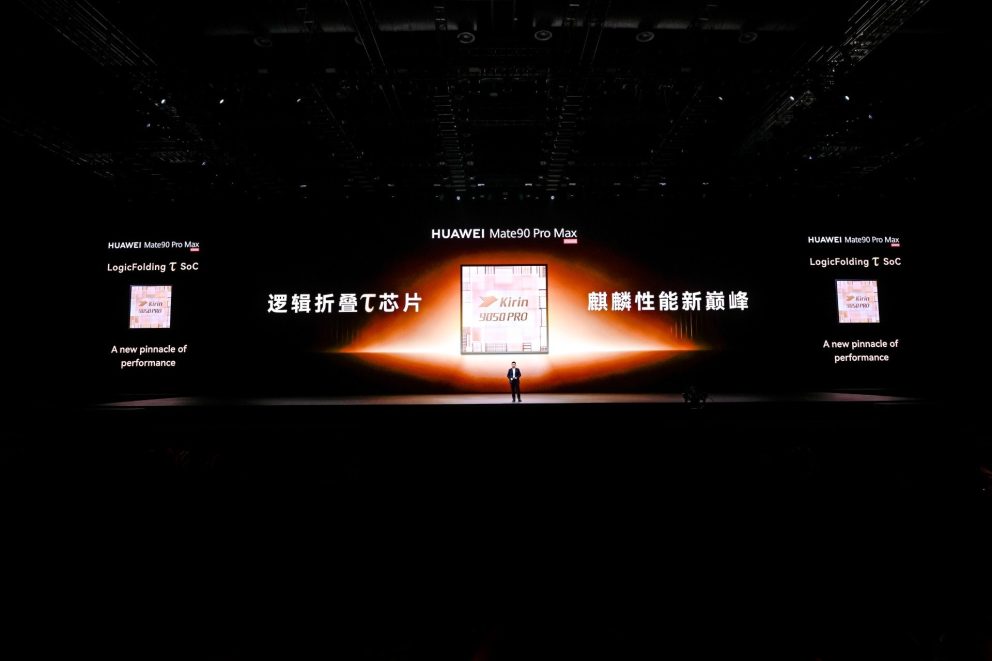
The Mate 90 series smartphones we just launched come with the latest Kirin 9050 Pro chip. The overall device performance is 31% higher than the previous generation. The Balong modem, image sensor processor (ISP), mobile security processor (MSP), Lingxi CPU, Maleoon GPU, and the NPU that adopts Huawei's Da Vinci architecture for AI processing are all designed by ourselves. They offer higher energy efficiency and deliver much-improved overall system-level performance, even though we have limited access to advanced semiconductor processes.
Recently, we have also made a new breakthrough in the semiconductor domain: the LogicFolding technology under the Tau Scaling Law. Unveiled by He Tingbo, head of Huawei's Semiconductor Business Department this May, this technology vertically stacks the logic layers of chips and restructures the circuit layout through inter-layer high-density interconnect to shorten critical paths and reduce latency. This technology was adopted on our Kirin 9050 Pro chip.
This chip also has very strong AI processing power. The Mate 90 series powered by this chip can run a 30B MoE on-device AI model.
We started the development of HarmonyOS in 2019. Before that, Huawei was a major contributor to the Android community as well as the entire Android ecosystem. After several years of hard work, more than 90 million devices, including smartphones, PCs, and tablets, currently run on HarmonyOS 6 and HarmonyOS 7. We expect this figure to hit the 100 million mark by the end of this year. Developing an operating system is no easy task, and the trickiest part was app development and ecosystem building. There were previous attempts by other large companies like Windows Phone from Microsoft, the bada OS from Samsung, and Symbian from Nokia. They were not successful. Even though we did it many years later, we have succeeded. I think this is certainly incredibly difficult to achieve.
The number of apps and services in the HarmonyOS ecosystem has already exceeded 450,000. Our global registered developer count has reached 11 million, and we have over 23,000 app innovation partners. Building this ecosystem in just a few years has been extremely difficult. I'd like to express my special thanks to all our partners and developers for their trust and support. We are considering gradually bringing HarmonyOS to the global market in the future. That's just our initial plan, though. We will do that slowly, step by step.
In the AI domain, Huawei provides the Ascend compute foundation. It's a very important business for us. In addition, we have large models called openPangu, and I'm also in charge of that business right now. Intelligent driving also relies on AI capabilities, and it's an area I was previously in charge of. And we have HarmonyOS Celia, which is similar to Gemini in the Google Android ecosystem.
We are also using AI to improve the O&M of communications network equipment. In addition, we combine AI computing power with domestic open-source large models to help enterprises and industries around the world, especially in China, use AI. We aspire to become an enabler for various industries in the age of AI, helping them use AI to become more productive and bringing more convenience to everyone. This is our vision and ambition.
As for our strategy for the overseas market, our smartphone business has been greatly affected since 2019. Our global market share was once No. 1, but now we only sell several million units of smartphones outside China every year. So we are trying to return to the overseas market step by step. However, some types of our products are selling pretty well outside China. In wearables, we are No. 1 in terms of the market share both in China and globally. Also, the market share of our innovative products like TWS earphones is growing fast, and has reached No. 1 in many countries. These products are very well received by consumers outside China. Our tablet and PC business was also greatly affected after we were denied access to Windows and Intel x86 chips. Our HarmonyOS-based tablets are now performing strongly. The volume is not as big as in the past, but it is continuously growing.
Another part of our business is CPE. It is a mobile router that provides connectivity to the unconnected in remote and rural areas. These products are also very well received across many regions outside China, helping more people connect to the rest of the world and live better lives.
Question: It's been about 15 days since the Huawei Mate XT 2 hit the market. Do you have any specific numbers regarding the sales or shipment volume of that model to share? Apple has for the first time launched its foldable form products as well. What are your thoughts regarding its impact on Huawei's position in this product category?
Richard Yu: The Mate XT 2 is the second generation of our tri-fold phone products. The sales volume of the first generation and its optimized model exceeded 1 million units. The second generation just hit the market this month. To date, we have already shipped nearly 100,000 units, and we estimate the total shipment volume to exceed 1 million units as well.
This product is selling very well, and demand currently exceeds supply. In addition to its wing-like tri-fold design and powerful hardware performance, another important reason for its popularity is the numerous innovations in terms of software and user experience that are loved by premium users. The HarmonyOS 7 that powers the phone is specifically optimized for the triple-fold design, adapting to the large screens and panoramic multi-screen scenarios. This phone also has a unique screen privacy feature that ensures user privacy without sacrificing screen display effects, and toggling the privacy mode on or off is quite easy.
We'll gradually make this tri-fold phone available in the overseas market. Many users in the Middle East and Asia Pacific love it. I also hope that we can bring it to other markets like Europe.
Huawei has been working on foldable phones for eight years and has always been a true pioneer when it comes to foldable phone innovation. For example, we are the first vendor to develop the "waterdrop" advanced precision hinge system, a technical breakthrough that ensures the foldable phone closes seamlessly with zero gap when folded.
I'm very pleased to see the recent launch of foldable phones by our US peer. Actually, we launched a similar product with landscape folding, the Pura X, in the spring of last year. Back then, we designed a smaller and also a bigger version of this foldable phone, and our original plan was to launch them at the same time. Since we devoted a lot of resources and efforts to building the HarmonyOS ecosystem, we postponed the launch of the bigger version, the Pura X Max, to April this year. When we were about to launch this widescreen foldable phone, we saw online reports about our US peer developing a similar phone. The widescreen foldable phone was originally from Huawei and we started earlier.
I'm very pleased that during the week after the launch of the iPhone Duo, the sales volume of our Pura X Max went up by 76%. Maybe that's because the consumers like our product more. Over the past several months after its launch, the sales volume of the Pura X Max has exceeded 1 million units. We welcome our peers to join us in the competition and deliver better products and services to consumers. Such healthy competition can also motivate more users to choose foldable phones.
Camera design for foldable phones has been a tough industry challenge due to the physical design constraints for camera modules. If you want better camera performance, the sensor area needs to be larger, which means the lens must protrude further. We are able to deliver superior camera performance for foldable phones thanks to our breakthrough in camera module miniaturization technology. The camera performance of our latest foldable phone rivals that of some flagship slab phones.
In addition, we have managed to ensure the reliability of foldable phone screens through continuous technological innovation. Users sometimes use their phones in low- or high-temperature environments. They sometimes drop the phone on the ground, which has an enormous impact on the hinge system. It is extremely difficult to address these issues. Huawei was the first vendor to make breakthroughs in many reliability technology domains, and has made many contributions to the whole industry.
As a pioneer, we have put in huge R&D investment. We've conducted extensive basic research and done a lot of reliability experiments to address numerous challenges. Since I myself am in charge of this business, I know how hard it has been for us to make these achievements. Today, we have a 75% share of the Chinese foldable phone market.
Question: You mentioned some products that are popular in overseas markets. Could you tell us which international markets you see the most potential in? What has Huawei seen in terms of the impact of the conflict in the Middle East on your consumer business?
Richard Yu: Many of our products are well received by consumers in the Middle East, Asia Pacific, some Latin America markets, and Europe, and we have a large number of loyal users in these markets.
For example, our wearables are very popular. The HUAWEI Watch has outstanding health and fitness features and is loved by consumers. I have been using our latest generation of smart watches that can measure blood pressure and assess blood sugar risks. This year, we will also launch innovative wearable products that directly deliver blood glucose readings. Other popular products include our earphones, tablets, as well as foldable and slab phones.
The conflict in the Middle East a while ago did affect the consumer market, and it is currently recovering. Overall, our whole consumer business is enjoying a positive momentum in markets outside China.
Question: With memory costs rising, in terms of pricing, Huawei has been quite restrained compared to other major brands this year. How has the memory shortage affected Huawei? Top vendors are pushing premium strategies. Huawei has many high-end products. What's your specific plan to regain growth overseas?
Richard Yu: The sharp price increases of memory components bring about an additional cost of more than US$200 for every phone. Since our phones have higher specs for memory components compared to other phones, the cost increase is higher. Overall, this is certainly a very big challenge for the entire industry. We're seeing many phone makers increase their prices. We are increasing our prices at a very slow pace, because we try to absorb the costs ourselves so that consumers don't have to bear such costs. But to be honest, our overall margins are declining sharply. Moving forward, we will have to increase our prices, too. If we suffer losses, our business will not be sustainable, and a company must be able to survive first.
After the smartphone price increases, the low-end segment is going to be more squeezed, which will drive vendors toward the mid-range and premium segment. The premium segment is an area Huawei has been good at. We have confidence that Huawei will remain in the game during the current round of smartphone price increases, and we will continue to provide consumers with even better innovative products, experience, and services.
In markets like Europe, phones are primarily sold through telcos. If we want to sell more phones in some developed countries, we will have to return to the telco resale channel. This is a possibility we are looking at.
Question: Both the Huawei XT 2 and the two most advanced models of the Mate 90 series use a LogicFolding chip. Will LogicFolding chips be used for more phones in the future? We understand that Huawei's chip production capacity is still limited. Huawei has launched SuperPoDs, and AI infrastructure is a huge business. They are both very important in China. How do you secure a larger share of the chip supply internally?
Richard Yu: We started introducing the chip that adopts the LogicFolding technology powered by the Tau Scaling Law to the Mate XT 2 tri-fold phone. To answer your question, yes, more of our phones will definitely use these LogicFolding chips in the future.
Currently, the production capacity for advanced semiconductors in China still cannot meet the rapidly growing demand. Huawei's Ascend chips for the AI domain also use such capacity. But we have developed a requirement plan, which also covers the chip requirements of smartphones.
The sharp price increase for memory components over the past two years has somewhat limited the smartphone sales volume. Even though the production capacity remains tight right now, generally it is sufficient to meet our market shipment needs.
We hope that production capacity will ramp up in China's semiconductor industry so that we can manufacture more advanced products for consumers in the Chinese market as well as the overseas market in the future.
Question: What's your vision for AI devices for consumers? How does the new chip technology change what that hardware can do? And do you need more domestic Chinese capabilities in other aspects of chip making, like EUV, to really realize this vision?
Richard Yu: Nowadays, mobile chips have a stronger processing and computing power. In the AI era, more powerful on-device AI computing power is certainly very valuable for rapidly processing local tasks. This means increasing requirements for the computing power of chips, which requires more advanced processes.
EUV tools are certainly key to manufacturing advanced chips. China is currently working on these tools, but right now we're still relying on DUV domestically. Our LogicFolding technology is just an approach we adopt to improve our capabilities when our access to certain technology is restricted.
At the same time, we leverage the higher efficiency brought by software, HarmonyOS, and the app ecosystem, and the synergy with cloud services to improve the overall experience.
The main processor of a phone requires advanced processes, but numerous other components of the phone do not have such high process requirements. Therefore, we have adopted a systems engineering approach to continuously optimize overall performance and compensate for not having access to more advanced processes.
In addition, our smartphones have very sophisticated cooling technology. We started working on this domain a long time ago and have conducted very extensive research. The Mate 90 series adopts our latest generation of cooling technology that brings lower power consumption and higher efficiency.
