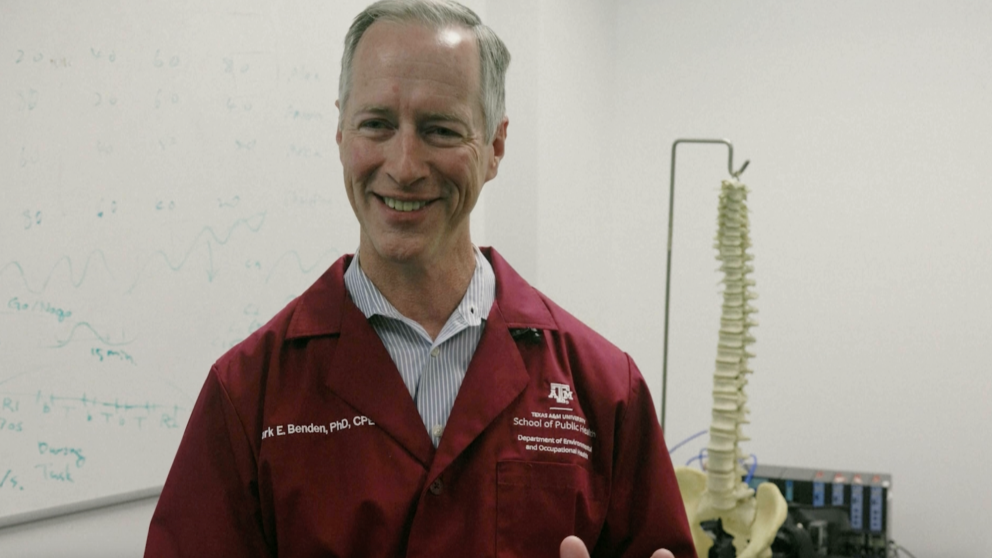

Dr. Mark Benden, Director of the Center for Worker Health and Professor at Texas A&M University, discusses research on increasing children's physical activity during school by using standing desks. In collaboration with the CDC, the study led his team to develop standing desks for classrooms.
In the video, Benden states that children today are the most inactive generation, and traditional after-school activities are not universally effective. Benden's team created an activity-permissive learning environment (APLE) with standing desks and standing stations. The standing desks encourage movement and activity, which has been proven to have positive effects on children’s engagement and focus.
When children are put into environments where they are allowed movement, children spend more time on tasks. Teachers also benefit by not having to correct behavior issues in the classroom which leaves more time for learning.
This approach improves focus, productivity, and classroom management. The initiative, now implemented in over 40 countries, aims to instill in children the expectation of active work environments, promoting lifelong health and productivity.
STORYLINE:
00:00
We had worked with the CDC a number of years ago trying to figure out how to get children to move more, sit less. Children had become very inactive, in fact, the most inactive generation that we've ever recorded. And so we knew that the one kind of window of opportunity that we had from a public health perspective was during school.
00:19
I am Dr. Mark Benden. I am the director for the Center for Worker Health at the School of Public Health at Texas A&M University. I’m also the department head for the Environmental and Occupational Health Department.
00:33
If you encourage children to do things like afterschool activities, that does work for some children, but it doesn't really reach out and touch all children. And so what we did was we came up with a way to create an environment — activity permissive learning environment, or APLE — a way to get those kids to move, and we found that creating stations that were standing was particularly helpful.
01:08
Children naturally like to wiggle. They like to fidget. They like to move and shake. They still believe that it's all about the Hokey Pokey. They know that they're supposed to have change and transition. And so, when we put a situation in kids' lives where they're allowed and encouraged to move, they do. Now, ironically, when we ask adults to do the same thing, they complain. But children love it. They embrace it. They want to wiggle and dance and move and be all over the classroom. They really enjoy that. So giving them a place where they can do that in a learning environment where they can still accomplish their tasks, what we found was that children had more time on task when they were in an activity permissive learning environment than when they were in the traditional, static environment.
01:57
And teachers love that because it helps them with their classroom management. When children are on on task, when they're focused, when they're doing their work, they're not bothering their classmates. The teacher is able to teach the material and not have to correct behaviors. And so it really works out as a win-win from an educational standpoint and a health standpoint.
02:18
And this is kind of hard because it goes against conventional wisdom of sit down, sit still, be quiet, do your work. When we do that for long periods of time, we become less productive. We need change and variety. Our bodies heal themselves through movement.
02:34
And seeing the smile on the children's faces, seeing the teachers having the stories where the child who was really having trouble staying engaged with the material, and suddenly they're focused, they're attentive, they're paying attention, they're on task, just helping us understand how the brain and the body are one. They work together. We often try to separate those two things. Say, well let me just work with your brain right now. It's like, no, you're getting the whole person. Their little body is part of that brain, too, and you've got to understand how to work with both at that same time.
03:10
And I think we're setting these children up now for adulthood to be folks who move more, right, transition more, change more. Have them have the expectation of an activity permissive work environment because they're coming from an activity permissive learning environment.
03:30
I think last count, we were in over 40 countries. Hundreds of thousands of schoolchildren have now utilized these standing desks that we designed here at Texas A&M.
03:44
Broll Provided: Benden in lab working with students.
20 September 2024
