
On June 23, 2016, British voters chose to leave the European Union, sending shockwaves across the continent. To mark the anniversary, the Bertelsmann Stiftung is publishing exclusive data tracking public opinion in the UK and the EU over the past ten years. The findings suggest that Brexit has neither triggered further EU fragmentation nor driven British and European public opinion permanently apart. Instead, they point to a shared preference for pragmatic cooperation.
Gütersloh/Berlin, June 22, 2026 – Fears that Brexit would trigger a wider exodus from the EU never materialised. By March 2026, only 21 per cent of Britons and 18 per cent of EU citizens believed that other member states would follow the UK’s example and leave the Union; less than half the level recorded in March 2018. While the result of the Brexit referendum in 2016 was narrow, such a majority has not reappeared since. Asked how they would vote in a referendum on EU membership, more than 50% of Britons have consistently said they would vote to remain over the past ten years. The most recent figures, from March 2026, show a stable majority for Remain, at 57 per cent.
The populist promise that people would be better off after Brexit proved false. Shortly after the referendum, Britons were relatively optimistic about their future outside the EU. A decade later, this Brexit optimism collapsed. In March 2026, only 41 per cent of Britons said they felt positive about their personal outlook for the future; a decline of 27 percentage points. Only 23 per cent said their economic situation had improved over the previous two years, down 21 percentage points. Overall, early Brexit optimism has given way to a wave of pessimism in the UK.
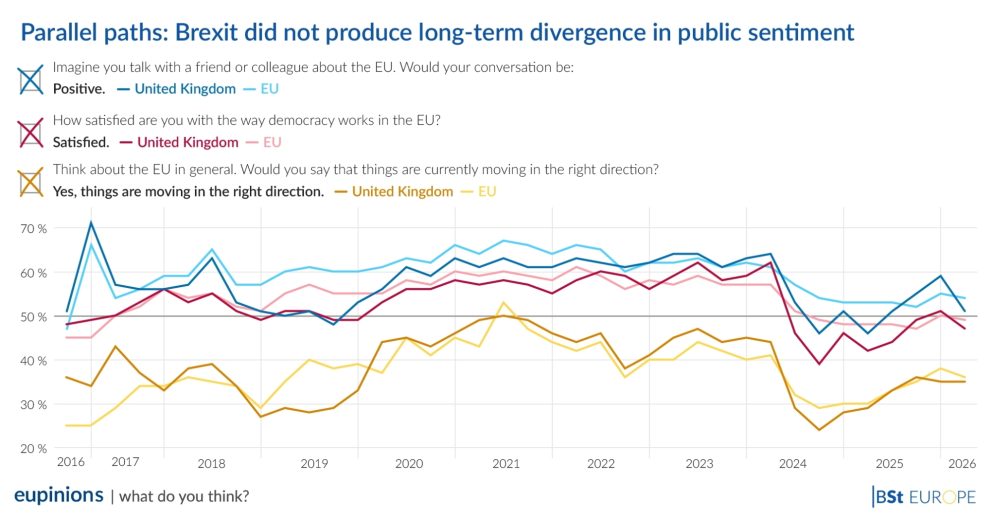
Brexit has not created a lasting psychological divide between British and European public opinion. Ten years on, Britons and continental Europeans increasingly share common concerns and expectations about Europe's future. By March 2026, attitudes were remarkably similar: support for a stronger EU role in world affairs stood at 66% in the UK and 71% acorss the EU, around half of respondents on both sides viewed the EU positively, and levels of satisfaction with EU democracy and perceptions of the EU’s direction were almost identical.
Jake Benford, Bertelsmann Stiftung’s UK expert, argues: "The public has moved on faster than politics. Citizens increasingly recognise that European fragmentaion comes at a cost: less security, less resilience and less influence in the world. The question is whether politicians can move beyond the divisions of the past and respond to this growing public pragmatism."
Florian Kommer, Bertelsmann Stiftung’s Europe Expert, commented: “In 2016, many believed the Brexit referendum marked the beginning of the end for the European Union. A decade later, the picture looks very different. Our findings suggest that the space for EU–UK cooperation may be wider today than is often assumed.”
The full dataset is available on our website: www.eupinions.eu.
21 June 2026
