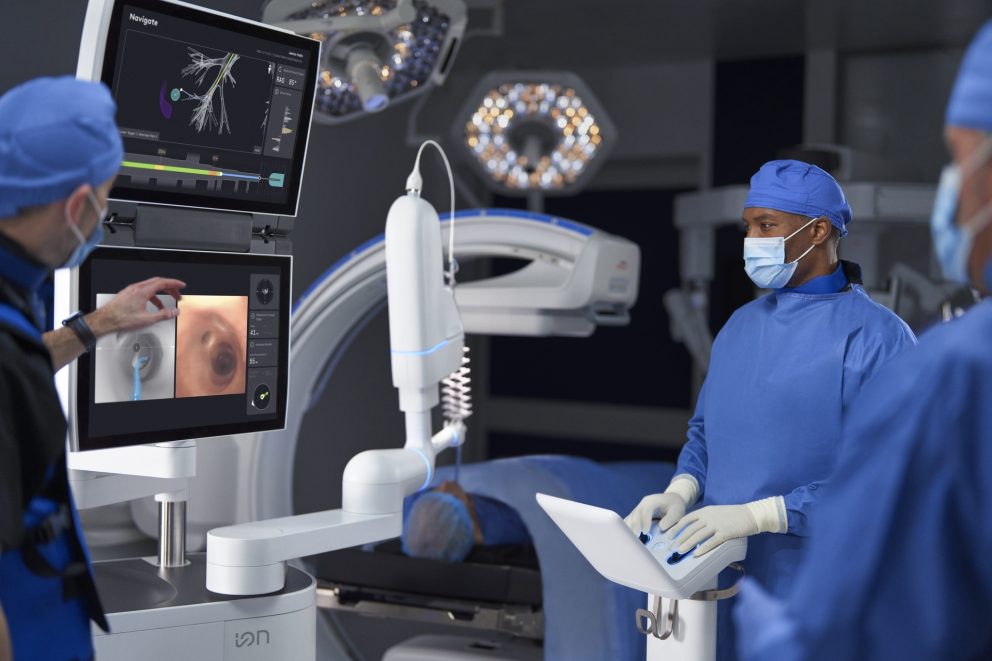

READING UK, 19 OCTOBER, 2026: Intuitive, a global technology leader in minimally invasive care and the pioneer of robotic-assisted surgery, today announced that clinicians across Europe have used the Ion endoluminal system (Ion) to perform more than 10,000 robotic-assisted bronchoscopy procedures since its CE mark in 2023, reflecting the growing adoption of the technology and its potential to support earlier diagnosis and treatment for patients with suspected lung cancer.
Lung cancer is the leading cause of cancer death in Europe.[1] Each year, around 480,000 people are diagnosed with lung cancer,[2] up to 70% of whom are diagnosed at a late stage when treatment options are limited and survival is poor.[3] When lung cancer is detected and treated early, five-year survival rates can reach up to 92 percent.[4],[5]
Diagnosing lung cancer often requires a biopsy of lung nodules, which are commonly found in tight spaces and narrow airways that may be hard to reach. This means that some patients with suspected lung cancer may undergo long periods of ‘watchful waiting’, while their nodule is monitored with imaging but not definitively diagnosed by biopsy, which may cause related anxiety and delay access to treatment options.[6]
Ion has an ultra-thin, shape-sensing catheter designed to navigate deep into the lung which can enable clinicians to access small, complex nodules and precisely position biopsy tools to sample potentially cancerous tissue with stability not available with manual bronchoscopy techniques.[7]
Dr. Oliver Wagner, Vice President and Medical Officer, Endoluminal Division at Intuitive, said: “Behind every procedure is someone seeking answers about a potentially life-changing diagnosis. Through Ion, our aim is to help clinicians replace that uncertainty with a clear answer earlier, ultimately leading to better clinical outcomes for patients.
“Reaching 10,000 Ion procedures across Europe is an important milestone, reflecting the dedication of pioneering clinical teams who have adopted and integrated robotic-assisted bronchoscopy into their lung cancer pathways.”
In 2025, a Europe-first multi-centre clinical study demonstrated that Ion enables clinicians to safely and effectively reach and biopsy small nodules in difficult-to-access areas of the lung,[8] with a high rate of diagnostic accuracy provided to patients.[9]
“As lung screening programmes expand across Europe, more potential lung cancers are being detected. With Ion, we remain focused on supporting clinicians to give their patients a clear diagnosis at the earliest possible stage - so they can access the right treatment sooner,” said Dirk Barten, Intuitive commercial president for Europe.
“Through our portfolio of Ion and da Vinci surgical systems and integrated Intuitive Ecosystem, our aim is to improve access to minimally invasive care. We’re working with healthcare systems across Europe to transform their lung cancer pathways, and help ensure more patients can access early diagnosis and improved clinical outcomes.”
Ion is part of Intuitive’s connected Ecosystem and full portfolio of robotic-assisted systems, each designed to help clinicians and care teams improve patient outcomes, enhance patient and care team experiences, lower the total cost of care, and expand access to minimally invasive care.
There are more than 1,000 Ion systems installed in hospitals globally,[10] which were used by physicians to perform more than 140,000 lung biopsies across the globe in 2025.[11]
About Intuitive
Intuitive (NASDAQ:ISRG), headquartered in Sunnyvale, California, with UK & Ireland headquarters in Winnersh Triangle, Reading, is a global leader in minimally invasive care and the pioneer of robotic-assisted surgery. Our technologies include the da Vinci surgical system and the Ion endoluminal system. By uniting advanced systems, progressive learning, and value-enhancing services, we help physicians and their teams optimize care delivery to support the best outcomes possible. At Intuitive, we envision a future of care that is less invasive and profoundly better, where disease is identified early and treated quickly, so that patients can get back to what matters most.
About the Ion Endoluminal System
The Ion Endoluminal System is a robotic-assisted, catheter-based platform that utilizes instruments and accessories for which the first cleared indication is minimally invasive biopsies in the lung. The system features an ultra-thin, ultra-maneuverable catheter that can articulate 180 degrees in all directions and allows navigation far into the peripheral lung and provides the stability necessary for precision in a biopsy. Information provided by the Ion Endoluminal System or its components should be considered guidance only and not replace clinical decisions made by a trained physician.
About da Vinci Surgical Systems
There are several models of the da Vinci surgical system. The da Vinci surgical systems are designed to help surgeons perform minimally invasive surgery and offer surgeons high-definition 3D vision, a magnified view, and robotic and computer assistance. They use specialized instrumentation, including a miniaturized surgical camera and wristed instruments (i.e., scissors, scalpels, and forceps) that are designed to help with precise dissection and reconstruction deep inside the body.
For more information, please visit the company’s website at www.intuitive.com/en-gb
This material may contain estimates and forecasts from which actual results may differ. Some products, features or technologies may not be available in all countries. Please contact your local Intuitive representative for product availability in your region. Refer to the product specific User Manual for indications, contraindications, warnings and other product information.
© 2026 Intuitive Surgical Operations, Inc. All rights reserved. Product and brand names/logos, including Intuitive, da Vinci, and Ion, are trademarks or registered trademarks of Intuitive Surgical or their respective owner. See intuitive.com/trademarks.
[1] Elmadani. M, et al. Cancer burden in Europe: a systematic analysis of the GLOBOCAN database. BMC Cancer. March 2025. Available at: https://link.springer.com/article/10.1186/s12885-025-13862-1
[2] Dyba. T, et al. The European cancer burden in 2020: Incidence and mortality estimates for 40 countries and 25 major cancers. European Journal of Cancer. November 2021. Doi: 10.1016/j.ejca.2021.07.039
[3] Van Meerbeeck. J, and Franck, C. Lung Cancer screening in Europe: where are we in 2021? Available at: https://tlcr.amegroups.org/article/view/50916/html
[4] Ning J, Ge T, Jiang M, Jia K, Wang L, Li W, Chen B, Liu Y, Wang H, Zhao S, He Y. Early diagnosis of lung cancer: which is the optimal choice? Aging (Albany NY). 2021 Feb 11;13(4):6214-6227. doi: 10.18632/aging.202504
[5] The Health Policy Partnership. Lung Cancer in Europe. Available at: https://www.healthpolicypartnership.com/project/lung-cancer-in-europe/
[6] Slatore CG, Wiener RS. Pulmonary Nodules: A Small Problem for Many, Severe Distress for Some, and How to Communicate About It. Chest. 2018 Apr;153(4):1004-1015. doi: 10.1016/j.chest.2017.10.013
[7] Intuitive data on file.
[8] Median size of the nodules was 13 mm. The mean nodule size ranged from 14 to 22.6 mm. Includes nodules located within 5 mm of the pleura (peripleural), fissure (perifissural) or a critical structure (eg, paramediastinal—heart, aorta or main pulmonary artery).
[9] Chan LT, Lau KKW, Orton CM, Temov K, Tana A, Baboolal I, Karir A, Agaoglu ES, Garner JL, Kalyal A, Lapuente M, Ttofia JF, Shah PL. Tool in lesion Verification of shape-sensing robotic-assisted bronchoscopy with cone beam CT in sampling peripheral pulmonary nodules. Thorax. 15 December 2025. doi: 10.1136/thorax-2025-223631
[10] Intuitive data on file as of Q2 2026
[11] Intuitive data on file as of Q4 2025.
19 October 2026
